


The commercial solar tax credit remains at 30%, but only for systems that begin construction by July 4, 2026, or are placed in service by the end of 2027. These timelines are now tighter than anticipated, increasing the pressure on developers to act fast.
Get a jump start on your solar project today by requesting a free quote below!
To discover the incentives, grants, and rebates available to offset the cost of installing a solar PV system for your home or business, as well as other types of renewable systems, we suggest you start with consulting with ECG Solar™; our extensive experience and knowledge of these programs can help identify applicable incentive programs for you.
Note: We do not offer CPA or investment advice and consulting, so we suggest you confer with your own professional to confirm how these incentives will impact your project and financial portfolio.
The 30% base, up to 50% tax credit for commercial projects has been extended and will be available through the end of 2027. This includes projects that are part of third-party ownership arrangements, such as leases and Power Purchase Agreements (PPAs).
A tax credit is an amount of money that taxpayers can subtract directly from the taxes they owe. Unlike deductions, which lower the amount of taxable income, tax credits reduce the actual amount of tax owed. A tax credit is a dollar-for-dollar reduction in the amount of income tax you would otherwise owe. For example, claiming a $1,000 federal tax credit reduces your federal income taxes due by $1,000.
Disclaimer: ECG Solar provides an overview of the federal investment tax credit for solar photovoltaics (PV) and battery systems. It does not constitute professional tax advice or other professional financial guidance. And it should not be used as the only source of information when making purchasing decisions, investment decisions, tax decisions, or when executing other binding agreements.
In order to claim a federal tax credit, the solar energy system must be in service during the tax year and generate electricity for a home within the United States. There are many stipulations that should be gone through and examined, the links to which can be found below.
30% Investment Tax Credit (ITC) , no cap on project cost, no refunds and does not qualify or IRA direct pay program. This Tax credit is still available until 2027.
The 30% tax credit for homeowners has been changed to expire on December 31, 2025. To be eligible, the solar system must be “placed in service” (fully installed) by this date. This is a change from the previous law, which had extended the credit through 2034.
Taxable entities may transfer any applicable credit to another taxpayer. Transfer may be all or a portion of the credit within 3 years and transferred only once. See section 13801 of the tax bill for more details.
Third-party-owned (TPO) residential systems are financed and receive the ITC via the business tax code. For details on the business ITC, see the next section. As before, a system is directly owned by an individual taxpayer and claims the personal tax credit or is TPO and has the tax credit claimed by the third-party owner, not both.
Extended at 30% through 2032; beginning with property placed in service after 2022, lifetime cap replaced with an annual cap of $1,200 except for heat pumps, heat pump water heaters, biomass stoves and biomass boilers which are capped at $2,000 in aggregate. Credit also applies to improvement to or replacement of a panelboard, sub-panelboard, branch circuits or feeders that have capacity of at least 200 amps and are installed to enable the “installation or use” other eligible property under this Section 25C.
30% Investment Tax Credit (ITC) up to $1,000.00, no refunds and does not qualify or IRA direct pay program. Carries over for 7 years if cannot be used all at once. Drops to 26% in 2033, 22% in 2034 and 0% in 2035.
30% Investment Tax Credit (ITC) up to $100,000.00 per charger, no refunds and does not qualify or IRA direct pay program. Carries over for 7 years if cannot be used all at once. Drops to 26% in 2033, 22% in 2034 and 0% in 2035.
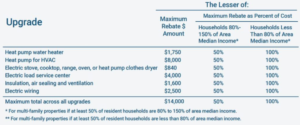
The IRA provides $4.3 billion to State Energy Offices to establish rebates for a variety of home energy upgrades under the Home Owner Managing Energy Savings (HOMES) rebate program. Rebates for home energy retrofits up to the lesser $8,000 per home or 80% of project cost if the project saves at least 35%. Lesser amounts available if projects save less than 35%. Multi-family rebates are also supported with different rebate amounts. Caps can increase for low- and moderate-income families with approval of the Secretary. Cannot be combined with High-Efficiency Electric Home Rebate Program.
30% Investment Tax Credit (ITC) for 3 kWh capacity or larger and can charge from any source, no cap on project cost, no refunds and does not qualify or IRA direct pay program. Carries over for 7 years if cannot be used all at once. Drops to 26% in 2033, 22% in 2034 and 0% in 2035.


9.08687 GWh
Clean energy produced

6,541,673.30
Metric tons of CO2 offset

16,237,777,839
Equivalent vehicle miles avoided
Made with ♥ by Aelieve.

